Week of March 16–22: autoresearch and nanochat field community contributions across performance, compatibility, and security—while jobs attracts accessibility and analysis upgrades.
autoresearch gets Apple Silicon with M3 Ultra port
Two competing PRs bring MPS support to single-GPU training, opening the door for researchers on Mac hardware.
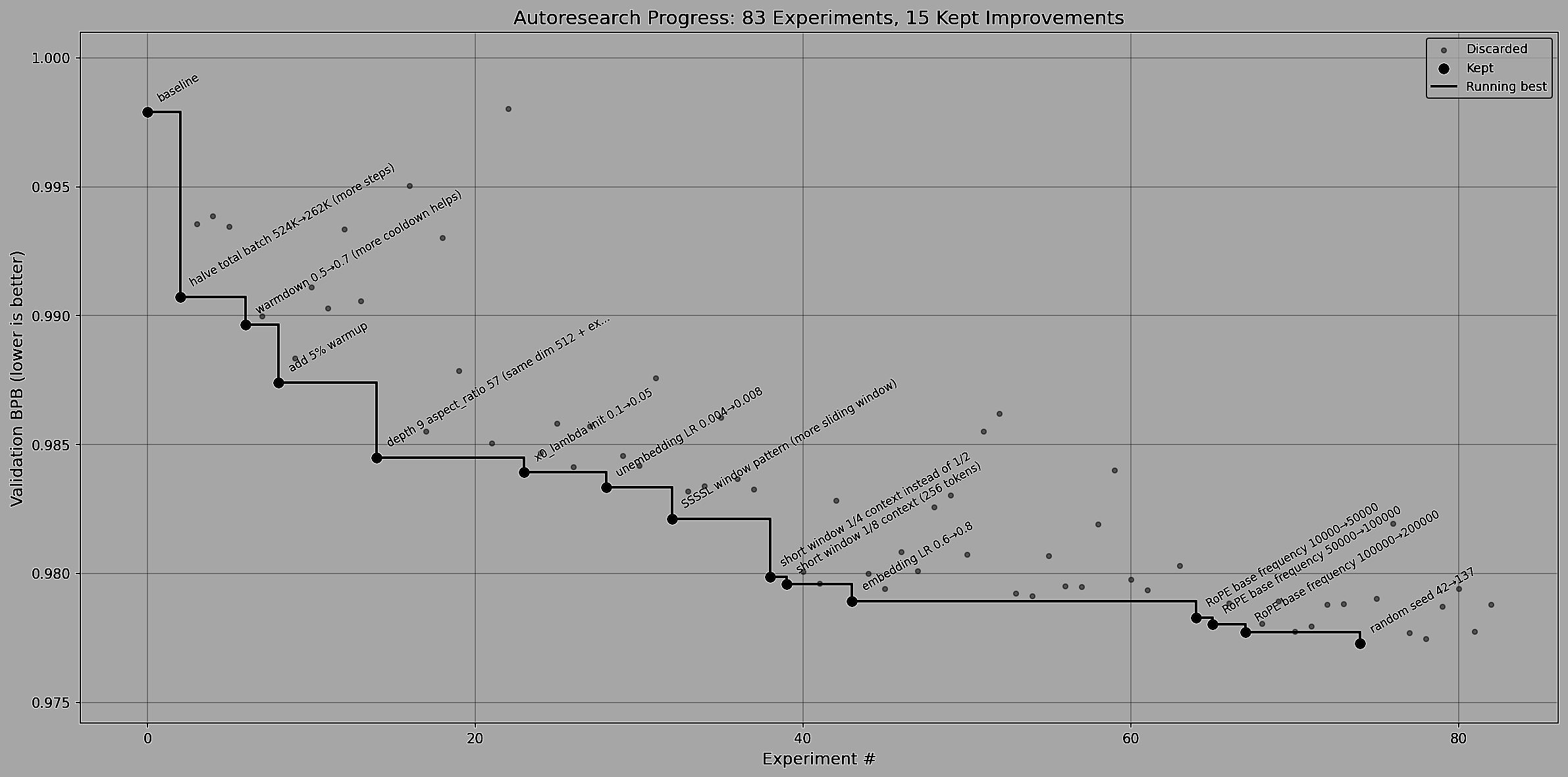
Contributors steefvw and jeong-sik independently submitted MPS (Metal Performance Shaders) ports this week, each targeting Apple Silicon acceleration. The Bach inventions PR and the M3 Max support PR represent parallel efforts to eliminate GPU dependency for the research automation pipeline. @karpathy now faces a pleasant triage problem: reconciling two paths to the same goal. Community is clearly signaling demand for Mac-native training.
nanochat tokenizer switches from pickle to JSON, fixing Docker on ARM
A serialization swap solves crashes on ARM-based container platforms without code bloat.
Contributor abcdedf identified that pickle-based tokenizer serialization was crashing nanochat inside ARM Docker environments. The fix trades pickle for JSON serialization, eliminating architecture-specific binary incompatibilities. Separately, vivian-my posted a 4.3% speedup through architecture and optimizer tuning (94.6 minutes baseline), showing the repo remains under active performance pressure.
autoresearch security PR demands weights_only torch.load
A hardening measure addresses arbitrary code execution risk in model loading.

Contributor robotlearning123 submitted a security fix requiring weights_only mode during torch.load operations, blocking deserialization of untrusted pickled objects. This is a high-signal defensive change for a tool that automates research pipelines—malicious checkpoint files could compromise experiments at scale. The PR also specifies safe exit protocols.
autoresearch experiments now print hyperparameters in final summary
A UX improvement logs training configuration for reproducibility.
Contributor mvanhorn added hyperparameter printing to the experiment summary, surfacing learning rates, batch sizes, and other config directly in final output. Small change; large impact for researchers reviewing logs weeks later.
nanochat CLI docs now show model tags in examples
Documentation clarity for users juggling multiple model checkpoints.
Contributor DeoJin submitted a documentation fix showing how to tag models in CLI examples, reducing friction for users managing multiple nanochat instances.
jobs gains AI Opportunity scoring layers
The Bureau of Labor Statistics visualization tool now surfaces AI advantage and growth metrics for occupations.
Contributors sidneyhori and Kovbo submitted AI Opportunity analysis layers and a composite scoring system that rank jobs by exposure to AI disruption and growth potential. The tool, a visual explorer of BLS data, now enables researchers to plot occupations against machine learning advantage. Separately, cartertemm contributed screen reader support, broadening accessibility.
autoresearch pulls in five pending contributions across splits, performance, and safety
A crowded inbox signals growing community investment in the research automation layer.
Beyond the Apple Silicon and security PRs, the week brought suffix preservation fixes in data splitting and continued discussion of deeper roadmap items: MPS tracks, JudgeModel evaluation, and data-centric research design. The open issues queue reflects ambitious thinking from contributors.
| nanochat |
|
49,844 |
| autoresearch |
|
48,261 |
| jobs |
|
1,023 |
-
autoresearch
AI agents running research on single-GPU nanochat training automatically2 commits · 0 releases · ★ 48261
-
nanochat
The best ChatGPT that $100 can buy.1 commits · 0 releases · ★ 49844
-
jobs
A research tool for visually exploring Bureau of Labor Statistics Occupational Outlook Handbook data. This is not a report, a paper, or a serious economic publication — it is a development tool for exploring BLS data visually.6 commits · 0 releases · ★ 1023